
Ellen Oredsson, Digital Projects Officer, Education & Outreach, The National Archives (2023-24 Fellow)
Project summary
The question I sought to answer with my project was: how can we make archives not just accessible for visually impaired students, but fun and engaging too? How does this audience group interact with archives, and what makes their archival experiences exciting?
To answer this question, I spoke to a wide range of people, gained a certification from the IAAP, and learnt about the variety of barriers that visually impaired people face in a society that is not accessible, and methods to remove or diminish those barriers.
My project resulted in the following:
- The creation of a specially designed classroom workshop aimed specifically at visually impaired students, and I was able to collaborate with New College Worcester to successfully test this workshop with a group of 11 blind and partially sighted KS 3-4 students.
- A toolkit summarising my learnings: Introducing Accessibility for Visually Impaired Audiences at Archives.
- The introduction of the use of an electronic magnifier for onsite education workshops.
- Improved departmental understandings of blind and visually impaired audiences, and how we can make our offerings more accessible.
What was your experience of your fellowship?
I prioritised research through talking to and collaborating with others. This is, firstly, because my research focused on an audience group with lived experience. Second, this is a field that relies on a variety of different technologies designed to improve accessibility. Talking to people who use and work with these technologies was one of the best ways to figure out which ones might suit my department.
My conversations with everyone I spoke to formed the basis of my improved understandings of accessibility, which was further bolstered by undertaking training and a certification from the IAAP.
One of the people I spoke to was George Rhodes, who is doing his PhD on tactile images for visually impaired audiences. We formed a collaboration that led to the creation of a pilot workshop designed specifically for blind and visually impaired students.
I also formed a connection with Jeanette Normanton-Erry, Head of History at New College Worcester, a specialist school for blind and visually impaired students. My connection with her led to us being able to trial the pilot workshop with a group of students from New College Worcester.
Finally, I formed a connection with Kate Antolak, a teacher who is also a blind Braille user. I hired her as a consultant for the project, and her advice was an invaluable part of the workshop design as well as providing training for Hannah Carter, the teacher who delivered the workshop.
The workshop was not just educational but also fun, as borne out by the feedback from the students on the day. More in-depth feedback was also collected by some of the teachers from New College Worcester who attended. This feedback will help us further refine the workshop, and we hope to trial it with other schools and student groups so that it can keep evolving and improving.
Reflections on your fellowship
My experience as part of the Professional Fellowship Scheme gave me an invaluable opportunity to do research that was meaningful to me. It was a fantastic experience and I learnt so much in just one year: improving my accessibility knowledge, my user-testing skills, and my presentation experience. Perhaps the greatest lesson learnt was the power of collaboration and partnerships, with the project unable to come together the way it did without me working with a group of fantastic and dedicated people.
This project was also marked by the mentorship embedded within the fellowship scheme. I was lucky enough to be assigned two mentors: Eleonora Gandolfi (The University of Surrey) and Anna Hvass (The University of Southampton). A project like this – with a short time span and a lot of potential avenues – can easily spiral out of control. Having mentors who could strategise with me helped keep things on track.
Since it was my first time organising a workshop of this kind, it was a learning process in the practical logistics that go into it, from organising parking to writing risk assessments. While this was challenging, the expertise and help of my colleagues were invaluable in overcoming these challenges. In the end, everything came together on the day to create a smooth experience.
My proudest moment was the workshop itself. Seeing students get to engage with our collections and learn about history through our documents was a great reminder of why this project exists in the first place. My initial objective was to create something that was not just accessible but fun for visually impaired students, and feedback gathered from the students confirmed that this objective was successfully reached! While it included helpful tips for further improvement, the overall feedback was very positive with the day being described as ‘awesome’ and ‘so much fun’.
Links:
Making archives fun for visually impaired students blog post
Toolkit: Introducing Accessibility for Visually Impaired Audiences at Archives
Karen Sayers, Archivist, Special Collections, University of Leeds (2023-24 Fellow)
Project summary
My fellowship ‘Visualising the Medieval Manor’ created a toolkit that helps archivists and librarians to support research and teaching in digital humanities using data from historical record series. Increasing interest in digital humanities and the development of visualisation software packages has opened new opportunities for analysing data. There are many series of historical records full of data in archives waiting to be explored using innovative technologies.
I wanted to identify resources to enable archivists to support researchers and academic staff carrying out digital humanities projects using data from archives. I decided that the best way to do this was by becoming a researcher and undertaking a mini digital humanities project. I chose to extract data from the Wakefield Court Rolls from 1331-32 and use the data to create visualisations to reveal aspects of medieval women’s lives to a wider audience.
I investigated what characteristics that data suitable for statistical analysis must have. I also examined how archivists could expand their current metadata and digital skills to support researchers and teachers. My primary output was A Toolkifor Archivists and Librarians Supporting Research and Teaching in Digital Humanities.
What was your experience of your fellowship?
I began by expanding my knowledge of digital humanities projects, searching for projects that have used data extracted from historical records series. Many have impressive search interfaces but what is not obvious is the painstaking background work necessary to make the data available.
The Wakefield rolls have been transcribed and uploaded to the Internet Archive, but the inconsistent punctuation and spelling of women’s names meant it was difficult to extract the data into structured columns in a spreadsheet. Consequently, I extracted the data manually and then standardised it. I already had many of the skills needed to cleanse data from my cataloguing work.
The biggest challenge for me was mastering the terminology and some of the functions of data visualisation software packages. I prefer in-person courses but accessed easily available online learning resources for PowerBI and Tableau Public software. My previous training on quantitative methods, although rusty, helped. I created graphs from data on women’s cases and found that the simplest visualisations were often most the effective.
Making the visualisations easily readable was sometimes difficult. Some looked clear on the software platform, but when transferred to another format e.g., blog posts, the titles and legends were illegible.
In a workshop, colleagues in Leeds Special Collections agreed my Toolkit and Case Study would help them to support digital humanities researchers and teachers. A PhD student from TNA (The National Archives) interviewed me, for my input to a resource for students undertaking digital humanities projects there.
Reflections on your fellowship
I enjoyed the opportunity to spend dedicated time on a current professional practice question. However, it was still a challenge to find the time to master the range of skills involved in a digital humanities research project, including extracting and cleaning data, and learning to create visualisations. I am pleased to have gained confidence and improved my ability to use visualisation software.
I think that there are so many different skills involved in carrying out a digital humanities research project, most are best undertaken by a collaborative team who can combine their respective abilities. Archivists and librarians are valuable contributors to, and partners in, digital humanities project teams, as they can share metadata skills and collections knowledge.
Since the Fellowship ended, I have been able to support a student intern working on a digital humanities project in Special Collections more effectively because of my own experience as a researcher. I have shared that experience with other archivists who will be supporting interns in future.
The Fellowship has led to my participation in a Leeds Special Collections’ Engagement and Communications Group. This is examining the type of resources researchers and academic staff would like to see on our webpages in future. My focus is exploring the cataloguing data and research data resources they require.
I recommend undertaking a fellowship to develop your skills and contribute to wider professional practice. My primary output A Toolkit for Archivists and Librarians Supporting Research and Teaching in Digital Humanities is available to help fellow practitioners.
Links to blog posts:
Leeds Special Collections:
- Using Historical Record Series in Digital Humanities Research (1)
- Using Historical Record Series in Digital Humanities Research (2): Data and Decisions
- Using Historical Record Series in Digital Humanities Research (3): Challenges and Achievements
TNA blog post
Jenny Shaw, Wellcome Collection, Head of Collections Development (2022-23 Fellow)
Project summary
My research project was ‘Improving diversity in UK archive collections: progress and barriers’ and looked at diversity and inclusion in archival collections development. It aimed:
- To raise the profile of collections development work and how this can support improving access, diversity and inclusion across the archives sector;
- To identify and highlight innovative practice across the archives sector which has contributed to increased diversity in collections;
- To identify barriers that inhibit, or prevent, progress in improving diversity in collections from becoming more widespread across the archives sector.
During my Fellowship I conducted background research using professional literature, attended a conference about archival surveying, spoke with relevant individuals at TNA, conducted interviews with nine selected people/groups trying to create more diverse archive collections, and presented my work at a conference. The work that I did was divided into three main areas: how archival theory can contribute to more diverse collecting; the different models of engaging with communities that are used; and recording and analysing acquisitions data. The third area of work was added during the course of the Fellowship and was the least well-developed strand.
What was your experience of your fellowship?
Broadly, I achieved what I set out to in my initial plan. My research evolved slightly as the Fellowship progressed. I had initially hoped to do some data analysis around archival acquisitions but the information was not in a suitable format to allow this to happen in the time available as it would have been a very complex piece of work. This did raise lots of interesting questions about reporting on acquisitions and measuring success which I’m still thinking about.
It was challenging to get everything done within the timeframe of the Fellowship. Inevitably, there were some pieces of work that weren’t finished within the Fellowship and which I continued to work on after the official end date. It was particularly difficult to have enough time to conduct the research and present it during the Fellowship so some of this happened afterwards, such as presenting at the ARA Conference.
Reflections on your fellowship
I successfully managed to ringfence time each week to work on my Fellowship. My role at Wellcome Collection is demanding, but making my Fellowship a priority brought me a lot of professional enjoyment. I had previously had vague plans to do more focused professional development but it was the structure of the Fellowship that actually motivated me to do this.
The Fellowship helped me to refresh and further develop my research skills, such as developing questions for interview and drawing up appropriate consent forms. The process of conducting the interviews helped me to develop my professional network with people who have a shared interest in how we develop collections. The whole process of conducting research and presenting it at a conference improved my confidence in talking about and formally presenting my work.
Links:
Authentic representation in archives: Reflections from our fellows
Vicky Iglikowski-Broad, The National Archives, Principal Diverse Histories Records Specialist (2019-20 Fellow)
Project summary
Professional fellowship with the Wellcome Collection entitled ‘Co-collaboration and challenging histories – exploring the most effective co-collaborative models to enrich heritage practice in research libraries and archives’. This fellowship sought to address the challenges and rewards of working collaboratively to enrich our understanding and interpretation of “challenging” or “sensitive” histories. This piece of work used the sample theme of sex work and the state as its focus, to show a case study in context. One of the proposed outcomes was a template of various collaborative models of engagement that could be used by RLUK and TNA member institutions.
What was your experience of your fellowship?
This fellowship was an important opportunity to dedicate time and space to thinking about the ethics of collaboration in an area that is still fraught with historic and current government tensions. Part of the understanding I gained through the project was when to pursue something and when to prioritise participant wellbeing. Early in the fellowship Covid 19 led to lockdowns, this limited original archival research and face-to-face collaboration. It also clarified the ethical time sensitivities around collaboration and when it is appropriate – this was not the time.
The project parameters accordingly shifted and I was still able to explore the theoretical challenges, research the complex collections material in this area, create guidelines for collaborative practice and design a template framework of prompts for navigating inclusive research and engagement.
I have been able to share this work through the WHELF Excluded Voices Conference, the Digital shift forum webinar series and DCDC, as well as a series of public blogs (linked below).
Reflections on your fellowship
The project taught me I could be agile and adaptable, and that it is important to prioritise participant wellbeing above all else, even when that means completely changing a project.
The framework has developed into a more substantial and cross-organisational piece of work, that has recently been disseminated to all National Archives staff, with associated engagement sessions. It’s great to have such a tangible, practical and long-lasting outcome from the fellowship. I look forward to seeing the continued impact of this. This work guided me to find some great archive items: from documents relating to male sex workers in the 1920s flirting with undercover police officers to the travel documents for migrating sex workers. It has encouraged me to be more intersectional in my approach and to look for moments of first-person narratives.
This work has revealed how against the odds, sex worker experiences and agency can still be found in a government archive. I continue to be approached occasionally by sex worker organisations or with funding opportunities to pursue this work and I hope the right opportunity comes together to develop this work further.
Working with the Wellcome Collection has been a great learning opportunity. I aspire to work more like them to always ingrain inclusion and collaborative practice.
Blogs
• Reclaiming the records: Sex work and the state – The National Archives blog
• Archives and agency: Sex work and the state – The National Archives blog
• A fellowship perspective: Collaboration and challenging histories – The National Archives blog
• ‘Importuning men’: Sex work and the male trade – The National Archives blog
• Reading against the grain: sex workers lives in a government archive by Vicky Iglikowski-Broad – Women’s History Network (womenshistorynetwork.org)
• Fragmented lives: Migrant sex workers’ lives in the archives – The National Archives blog
Ailie O’Hagan, Queen’s University Belfast, Digital Preservation Librarian (2024-25 Fellow)
 Project summary
Through my fellowship, ‘Accessible Preservation’ I explored inclusive approaches to preserving born-digital assets. While many institutions have introduced digital submission processes for research files, conditions intended to improve ease of deposit and access to research can inadvertently compromise preservation down the line, e.g., as researchers compress, optimise, or hyperlink content to meet upload capacity. This process can detach researchers from long-term preservation decisions about their work.
To address this, I developed a ‘thought tool’ which helps researchers to think about the essential qualities, or ‘significant properties’ of their digital files and take small steps to improve the preservability of these.
This tool was informed by a File Format Survey that I conducted with 168 researchers from Queen’s University Belfast, as well as 3 Focus Groups with practitioners from the wider Digital Preservation community. These highlighted practical approaches to make engagement with threshold concepts of digital preservation more accessible to researchers. My findings emphasised a need to incentivise preservation by tailoring guidance to researcher priorities. In addition, I modelled a process by which this tool can be integrated throughout the research and submission journey.
By including depositors in the preservation process and identifying practical decisions to support preservation of born-digital assets, the tool supports researchers with making informed decisions which can ultimately improve the longevity of their research.
What was your experience of your fellowship?
Since my fellowship aimed to include researchers in the preservation process, it was important to take account both of researcher perspectives as well as those of preservation professionals. To do this, I used an affinity diagramming approach to design the research: pairing researcher file-handling motivations identified via survey, with good-practice advice gathered in practitioner focus groups and from my residencies at The National Archives.
The chance to present my topic at the DPC Unconference, and early findings at the International Conference on Digital Preservation, iPRES 2024 helped refine my project and broaden my perspective, ultimately leading to a more sustainable solution by taking on board feedback to address preservation much earlier in the creation stage.
While the survey confirmed some discipline-specific issues, in general, findings showed that researcher motivations are broad and varied, reflecting the experimental and interdisciplinary nature of research.
In the focus groups, peers suggested a solution could cater for diverse researcher goals (e.g. whether to prioritise preservation of the information content, versus the experience of the work), observing the importance of ‘incentivisation’ of preservation—which became a core idea behind my tool.
Besides my own limitations as a beginner coder, a challenge lay in creating a tool that would not only be accessible for researchers, but would also follow digital preservation ideals by not being dependent on specific rendering software.
I decided to design the tool as interactive pathways in the open source platform, Twine. This allowed me to create a simple HTML file that can be opened in any browser. User-feedback was really positive—researchers felt the simple text and clear layouts made the information more accessible, while being able to self-navigate through the tool created a more personally meaningful experience, and prompted curiosity to learn more. Gamifying preservation advocacy in this way created an unexpected opportunity for me to become involved in a fun Digital Preservation Games Group !
Reflections on your fellowship
The tools and skills I learnt over the course of the Fellowship, and particularly during my visits to The National Archives, were transformative for my work practice. The Fellowship project was an invaluable opportunity to reflect and improve on early workflows, benchmark against peer institutions, and adopt good practices. I learnt a lot of technical tools and skills to add to my digital preservation toolbox, and am immensely grateful to my two mentors Melinda Haunton and Francesca MacKenzie, who supported me through this incredible learning curve.
Something that worked really well for me, was building in opportunities for peer feedback at different stages of my project, which helped me focus on key milestones within the short timeframe of the fellowship. For instance, I introduced the topic at the DPC Unconference, presented early findings in a poster at iPRES 2024, and was able to promote my tool by presenting at RLUK 2025. Joining a Python Study Group with the DPC and Bit Curator Consortium also gave me monthly motivation to keep experimenting with coding the tool.
The opportunity to present a poster and a paper at my first big conferences helped me to articulate and engage in discussion around my project, and wider digital preservation issues and developments. I developed a lot of relationships through the Fellowship and through these new connections, I was invited to join several groups in the UK and Ireland.
The Professional Fellowship was a great confidence booster at an early stage in my career, and has enabled me to become a more active participant in the Digital Preservation Community. I couldn’t recommend the programme highly enough!
Links
Bernard Ogden, The National Archives, Digital Researcher (2024-25 Fellow)
Project summary
My project explored prototyping for cross-disciplinary collaborative learning, bringing digital and collections specialists together to explore a digital method for working with collections. The findings should apply to a range of digital methods but for this project the focus was topic modelling, a statistical method that seeks to identify topics within a text through associations of words. This method identifies words that appear to relate to some topic but cannot identify the topic itself.
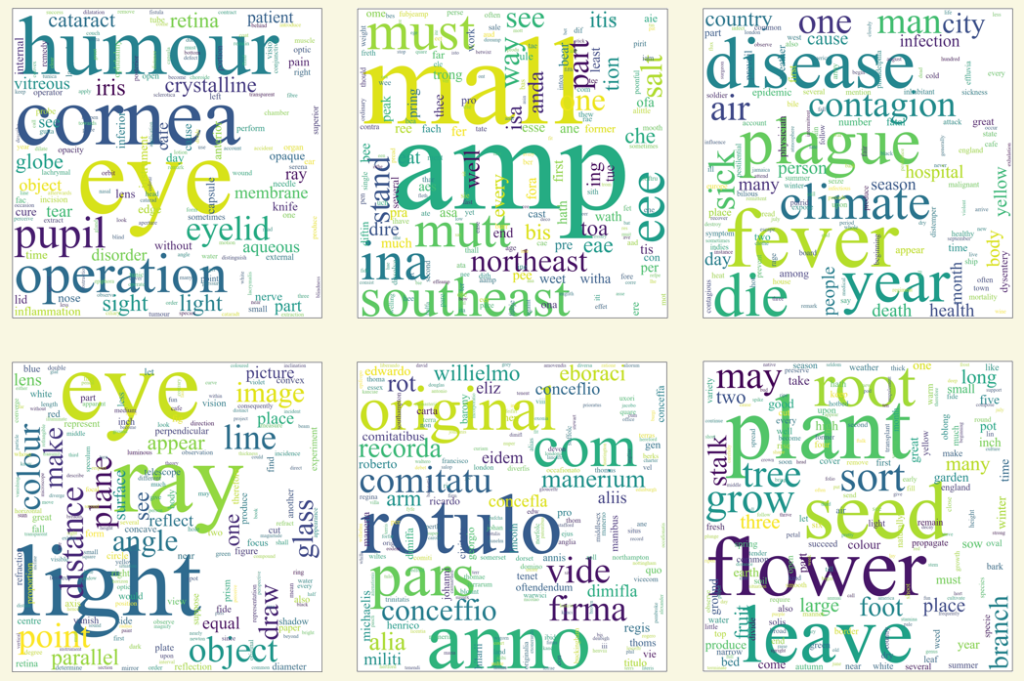
Six “topics” represented as word clouds of words that are important to the topic. Some – but not all – of these word clouds are suggestive of particular topics.
I built topic models of Wellcome Collection’s collection of eighteenth century books, and rough visualisation tools to explore the collection through topics. I brought these prototypes to short workshop sessions with digital and collections specialists from Wellcome, using the prototypes as a basis for discussion across professional perspectives about the potential for such tools, and to find a direction for the next round of prototype development.
The project’s main outputs were:
- A report on digital prototyping to facilitate cross-disciplinary collaboration
- A Jupyter Notebook that walks through one way of working with Wellcome Collection’s digitised text
- PowerPoint presentations from the workshops
- Prototype software for creating and visualising a topic model of Wellcome’s digitised text
- A poster for The National Archives’ Annual Digital Lecture
- A post for The National Archives’ blog (forthcoming)
What was your experience of your fellowship?
I delivered seven workshops over seven months, including three in quick succession during a two-week visit towards the end of the fellowship. Three of the workshops involved demonstrating prototypes that I had built. Though I attempted to reuse existing work, particularly Voyant and the Hansard Topic Relevance Identifier, my abiding memory of this period of the project is intense digital development sessions to get a prototype ready for the next workshop – and then of course preparing the workshop itself.
One challenge was keeping the projects interesting and relevant for participants and I was not wholly successful at this as later workshops attracted fewer participants. This was a useful learning point which led to a shift in emphasis for the final two-week visit, moving away from my own prototypes and inviting participants to think more broadly about digital methods and the audiences that they could serve. Although this did not actually attract more participation, it did allow me to explore a different approach which I could compare with the more detail-oriented prototyping method. These workshops seemed to generate more discussion, but the earlier prototyping focus may have laid necessary groundwork.
Reflections on your fellowship
The Fellowship carved out time that allowed me to focus on a bigger project more aligned to my interests and more focused upon a particular collection than is normally possible in my day to day work. It was really valuable for building skills around developing and delivering workshops and around working with digitised historical text. Part of the design of the project was that I was learning the digital method along with the workshop participants – this was challenging but also very educational.
Viewing the collection through a “topic lens” seems to have potential for exploration and serendipitous discovery as topics sometimes throw up surprising content or seem to combine two concepts in interesting ways. I am curious to see how this technique can be developed for this and other purposes.
I have also learned a lot about the practicalities of collaborative learning through prototyping. There is a huge difference between thinking about this in the abstract and the actual experience of doing the work. The Fellowship has highlighted challenges including delivering the digital work within a tight schedule and keeping the workshops relevant and useful for a wide range of participants, but also showed some value in the approach for at least some of the participants.
Links
Sarah Wood, University of Leicester Archives & Special Collections, Assistant Archivist (2024-25 Fellow)
Project summary
During my year as a TNA-RLUK Professional Fellow, I addressed the following professional-practice question:
‘How can archive services support the wellbeing of staff who encounter challenging records unexpectedly?’
I focused specifically on unexpected encounters, those moments when staff come across difficult content without warning or preparation. This can happen during routine tasks like answering enquiries, appraising new deposits, cataloguing, digitising, or researching for exhibitions. Without content notices or mitigations in place, these moments can catch staff off guard and could have an adverse impact on their emotional state, either in the short, medium or longer term.
The Fellowship provided the opportunity to engage with current discourse on the topic, gather insights from professionals across the archive sector, and develop a practical response: a talking Toolkit for line managers.
The Challenging Records Toolkit is designed to:
- Facilitate open, supportive conversations between managers and staff
- Encourage active listening and empathy
- Suggest practical control measures and signpost to organisational support services
The Toolkit is not intended to replace professional mental health support but to bridge the gap between sector-wide guidance (such as ARA’s Emotional Support Guides and The National Archives’ risk mitigation resources) and day-to-day organisational practices.
What was your experience of your fellowship?
To help organise my work around my substantive post at the University, I decided to divide the project into four phases.
- Phase 1: Undertake self-directed online learning and literature searching. This included completing the online course ‘A Trauma Informed Approach to Managing Archives’
- Phase 2: Deliver introductory workshops, obtain approval from the University’s Research Ethics Committee, and conduct interviews with a small number of participants working in the UK archive sector
- Phase 3: Analyse interview data and identity key themes to address in my project output. Create a practical resource adaptable for use by archive services across the UK
- Phase 4: Pilot The Challenging Records Toolkit at workshops to gather feedback
An initial challenge was defining the project and limiting my research area. Particularly in Phase One, I found that the more I read, the more avenues there were to explore. This is where support from the scheme’s mentor was invaluable. Working closely with a mentor who had experience in research enabled me to approach the project systematically and draw on their level of expertise.
Another aspect I found challenging was submitting an application to the University’s Research Ethics Committee. Their approval was required before I could commence my interviews. I had no previous experience in this so it was certainly a learning curve!
The application was a lengthy process which comprised of an online question-based application form. The application also required the completion of various risk assessments, a privacy notice, interview questions, consent form and participant information sheet.
Although challenging, undertaking this process helped me to devise a robust plan for the scheduled interviews and enabled me to reassure participants that their data would be thoroughly protected.
Reflections on your fellowship
The Fellowship allowed me the chance to dedicate time and resources towards a project I was passionate about. It provided the opportunity to work collaboratively with The National Archives to explore ways in which the sector can better support staff who have been impacted through their work with challenging records.
In addition, the scheme has helped further my professional development. Alongside training activities outlined in my CPD plan (a requirement for the application), the nature of my project has enabled me to develop in the following ways:
- Engaging with a new research methodology (interviews and qualitative data analysis)
- Research project management
- Delivering feedback gathering workshops
- Writing project reports
- Cross-departmental collaboration within the University (for example, the University’s Occupational Health Service)
- Presenting my first conference paper (at the Archives & Records Association’s conference, 2025)
Links