
Fellowship spotlight
Alison Harvey
Supporting research with digital archives at Cardiff University and beyond
Alison Harvey is Archivist at Cardiff University Special Collections and Archives. Her research explores the potential of minimal computing tools for supporting digital archives and exhibitions.
Project brief:
Alison’s fellowship developed practical case studies to examine the extent to which Cardiff University’s current digital infrastructure could support the sustainable creation and use of digital archives and exhibitions. She also published a website containing overviews and tutorials of free alternative methods and tools for creating digital archives and exhibitions, to support the wider Higher Education sector.
While the fellowship made me a better researcher, it also made me a better research supporter. I can far better understand some of the challenges faced by my academic colleagues, and I have a renewed respect for all the work that we do in libraries to support them.
Introduction
The fellowship represented a unique opportunity to progress a new area of research that I had undertaken of necessity during the COVID-19 pandemic, but which was not officially part of my role as an archivist.
Following an urgent need to support remote teaching and research activity during lockdown, I had pivoted from archival collections work to researching options for free digital hosting, coordinating metadata, and managing digital archives. At that time, we had digital content in storage, but no means or budget to make it publicly available to remote service users.
As I worked on these challenges, I developed expertise in a wide range of free and low infrastructure tools, methods, and resources for making digital content publicly available, including the International Image Interoperability Framework (IIIF).
In response to this growing experience and skillset, I was subsequently assigned to project manage the implementation of Alma Digital, a new digital repository with support for IIIF. Aside from the key requirement to provide remote access to special collections, another large driver for this investment was to meet staff and student demand for support for digital humanities research outputs. Until this point, staff and students had been required to set up personal accounts to host their digital archives on external platforms like WordPress and Instagram, which inhibited their sustainability. The fellowship offered the opportunity to test our new digital repository against staff and student needs, identify areas for improvement, and pilot a new library support service for the design and publication of digital humanities research outputs.
The fellowship was an opportunity to consolidate and put into practice digital skills and competencies I had acquired, but was under-utilising due to the competing demands of my substantive role, and to undertake further research and training that has significantly built upon this skillset. The fellowship provided dedicated time in which to undertake focused, uninterrupted, high-quality research and development, free from the diverse demands of archive service delivery.
Research journey
There were two strands to my project – the first to analyse the capacity and capability of Cardiff University’s new digital infrastructure, and the second to create a resource guide to free tools to support those lacking a digital infrastructure, informed by my experiences during the pandemic.
Within the first strand, I consulted with staff and students to identify areas in which support was needed to create digital research outputs. In response, I designed and created four proof-of-concept models for student outputs from the Schools of Welsh, History, and Architecture, which either used or integrated Alma Digital, Cardiff’s newly implemented digital repository, with other free tools. These included an illustrated, annotated bibliography in Xerte, a digital archive in Alma Digital, a static digital exhibition in Wax, and a geotagged photography archive in CollectionBuilder.
These case studies tested Alma Digital’s capabilities and integrations against a set of real-life requirements and limitations, and documented the findings in an internal report. The research exposed a previously unidentified issue with IIIF integration, which required communication and advocacy with the product’s vendor, Ex Libris, to pursue its resolution.
Within the second strand, I had the opportunity to test out all the digital tools and methods I had heard about over the preceding couple of years, but had struggled to find time to explore. During this process of testing and investigation, some stood out as particularly useful, and I published Minimal Digital on GitBook to summarise these findings. The site introduces IIIF principles, and provides overviews and tutorials for the free digital curation and exhibition tools I found most useful and least restrictive, including Storiiies, Exhibit, Padlet, Google Sites, CollectionBuilder, and Wax.
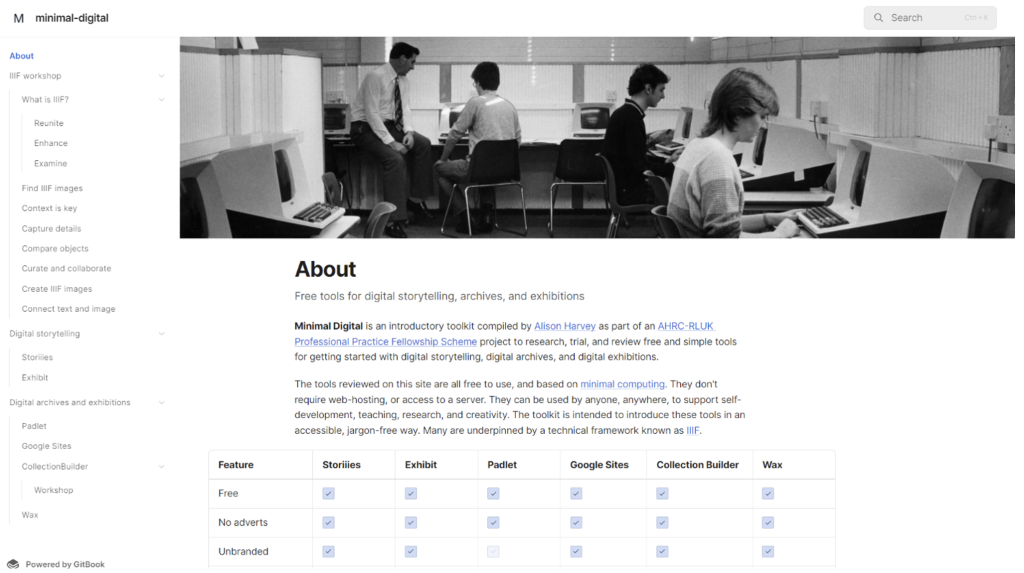
Since the publication of Minimal Digital, I have had requests to write and deliver new lectures for History MA students on public history, digitisation, and digital archives, and for English MA students on digital exhibitions – all are now an ongoing commitment as part of our Special Collections teaching programme. I have continued to revise and update Minimal Digital’s content in response to requests from colleagues within and outside the University. The website now includes introductory training in IIIF, which I utilised in an online workshop with RLUK colleagues in March 2024. It also includes a tutorial for making a digital exhibition with CollectionBuilder, which I have used to structure new in-person workshops with our History undergraduates, who have been tasked with creating digital outputs for assessment for the first time.
Impact
The fellowship has had a sector-wide impact, through advocacy for development work on Alma Digital that benefitted a global customer base, and through raising awareness of IIIF.
In recent months, Ex Libris have founded an international working group, which I have been invited to join. We will be responsible for representing the needs of customers to the company, and advocating for development priorities, including IIIF integration.
In early 2024, I was invited to present and co-host a series of four IIIF events for the RLUK Digital Shift Forum. This was a welcome opportunity to raise awareness of IIIF in a way that was less technically-focused, and more aimed at the specific needs of the library and archive sector.
The fellowship has had an impact within Cardiff University by supporting investment in digital infrastructure, and raising the profile of Special Collections within the research community.
The fellowship was cited in an internal application for a £241,000 Research Infrastructure Funding grant, as evidence of a wider University acceleration in digital research initiatives. The grant success has funded the purchase of high specification digital capture equipment for a new digital studio, which I now manage as part of my role, on the justification that quality equipment is required to scale up digitisation activity to meet future, ambitious research needs.
I was invited to join the Advisory Board of an AHRC-partnered digital scholarship research project. As part of this, I line-manage the project’s software developer. Having a digital humanities software developer based within the Special Collections team is a first for Cardiff University. It firmly centralises and formalises the important role we play in supporting digital humanities research.
The fellowship has had a personal impact – raising my profile within the sector and the wider research community, and allowing me to access new networking opportunities.
As well as speaking at Ex Libris’ international conference, I was invited to give a keynote at JISC’s Connect More 2023 conference, as well as giving papers at RLUK23, the IIIF conference, and an academic Illustration Studies conference. I also successfully obtained funding to attend a week-long ‘Digital Humanities in the Classroom’ training course at University of Pennsylvania. I have been assigned to represent Cardiff University on the RLUK Digital Scholarship Network, and appointed University Theme Lead for Digital Cultures and Adaptive Technologies, as part of a new strategic partnership between Cardiff University and the National Museum of Wales. I will be coordinating university proposals for digital-related research and grant bids, and liaising with our equivalents in the Museum to encourage cross-institutional collaboration and ambitious change.
Reflections
The experience has taught me that in planning for research, I need to expect the unexpected – rather than what can be achieved in predictable conditions.
As a result of the fellowship, I have a far better appreciation of the importance of building supportive communities of practice. Early on, my focus was on working independently to deliver the project objectives, and when my research revealed an issue with IIIF integration that prevented this, the problem seemed insurmountable. How could one person influence change in a large, global software company?
I had to overcome a reluctance to ask for help, and by utilising blog posts, social media, and Slack channels to reach out to wider technology communities, was able to gather enough information to speak to developers in their language about the precise nature of the problem. If the issue had not arisen, I would still have delivered the project objectives, but I would not have had the opportunity to build a supportive network of contacts in a new research area.
In terms of lessons learned, the original scope for the project was, in retrospect, over-ambitious. I had intended for Minimal Digital to include resources for supporting digital humanities research, but I now realise that would have required research time far in excess of that available during the fellowship. A compounding factor was the unforeseen effects of the IIIF issue encountered, which consumed a considerable amount of time and effort to diagnose and resolve, disrupting my intended schedule early on. However, the experience has taught me that in planning for research, I need to expect the unexpected – rather than what can be achieved in predictable conditions.
I struggled with motivation and morale at times. I missed the structure of library work, and the support of my team. There were days when I felt I was making no progress, and I think this was due to working in a way that was very new to me. In a service environment, librarians and archivists support researchers through multiple transactions a day, usually receiving grateful acknowledgement, and at the end of each day, we can be confident that we did a good job.
Conducting research is not like that. It can be slow; it can be lonely. There may be very little reassurance or sense of progress in the short term, and it might take months or even years before a researcher feels like they did a good job. Reflecting on the fellowship period at this point makes me realise how much has been achieved, but at the time of undertaking it, that was certainly not my perception. As a result, I would say that while the fellowship made me a better researcher, it also made me a better research supporter. I can far better understand some of the challenges faced by my academic colleagues, and I have a renewed respect for all the work that we do in libraries to support them.
Through the fellowship, I have had the opportunity to cultivate a new skillset, and build capabilities above and beyond my previous ambitions. I am deeply grateful for the opportunity afforded to me by the fellowship, and very much hope to see it continue in future iterations.